
The audio-psycho-phonological assessment
The listening assessment (audio-psycho-phonological assessment) is a test that looks at a person's listening posture and hearing curve. It is similar to a traditional hearing test, but it focuses on the active side of the ear. It is the starting point of Tomatis treatment, so that we can understand the person's needs and the best approach to take.
Updated on , a 2-minute read.
On this page
Every Tomatis journey begins with an assessment of your listening posture, which we call the “audio-psycho-phonological assessment”. What is listening posture? It is what you use, consciously or not, when you pay attention to a sound, a noise or a conversation. Why audio-psycho-phonological? Simply because Tomatis showed that listening is at once sensory, motor and emotional.
The term “audio-psycho-phonological” is used because Tomatis saw listening as a combination of sensory, motor and emotional processes.
In practice, how does the assessment work?
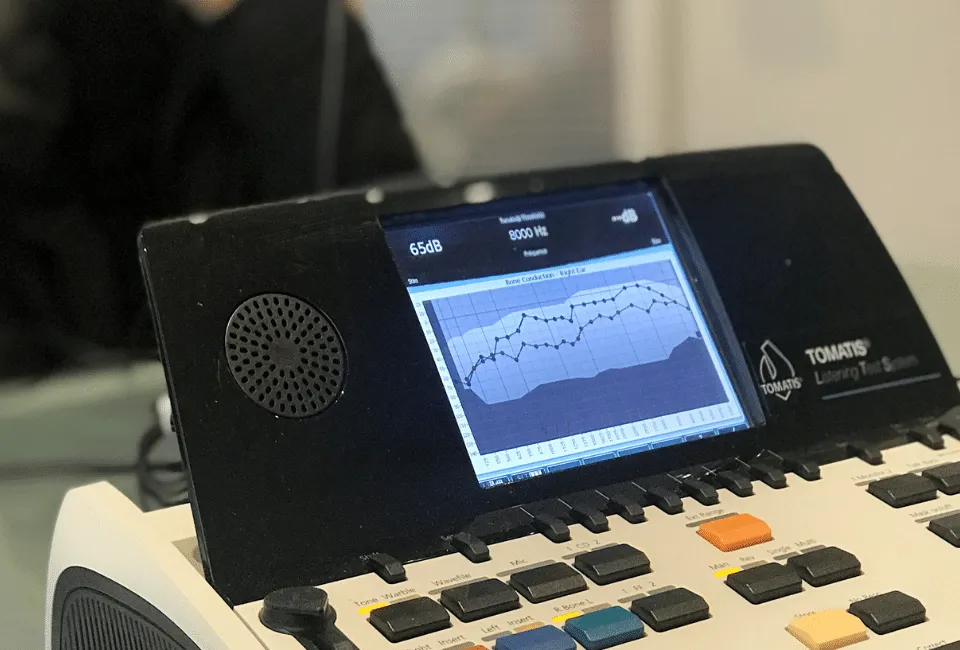
The assessment is similar to a hearing test as carried out by an ENT specialist or a hearing aid audiologist. We test 25 frequencies in each ear, which gives us an excellent “resolution” of the hearing curve. By comparison, an ENT specialist assesses only 7 to 11 frequencies. You should also know that the testing device we use is calibrated differently, because what we are measuring is alive.
My ear is alive? What does that mean?
The ENT specialist works on the basis that sounds are passed on passively, rather like a microphone. For Tomatis, however, the ear is an active organ: it takes an active part in how we perceive the sounds around us. For example, it protects you from dangerous noises, or filters out unwanted sounds during a conversation in a restaurant. This would not be possible if the ear were purely passive.
What the results look like
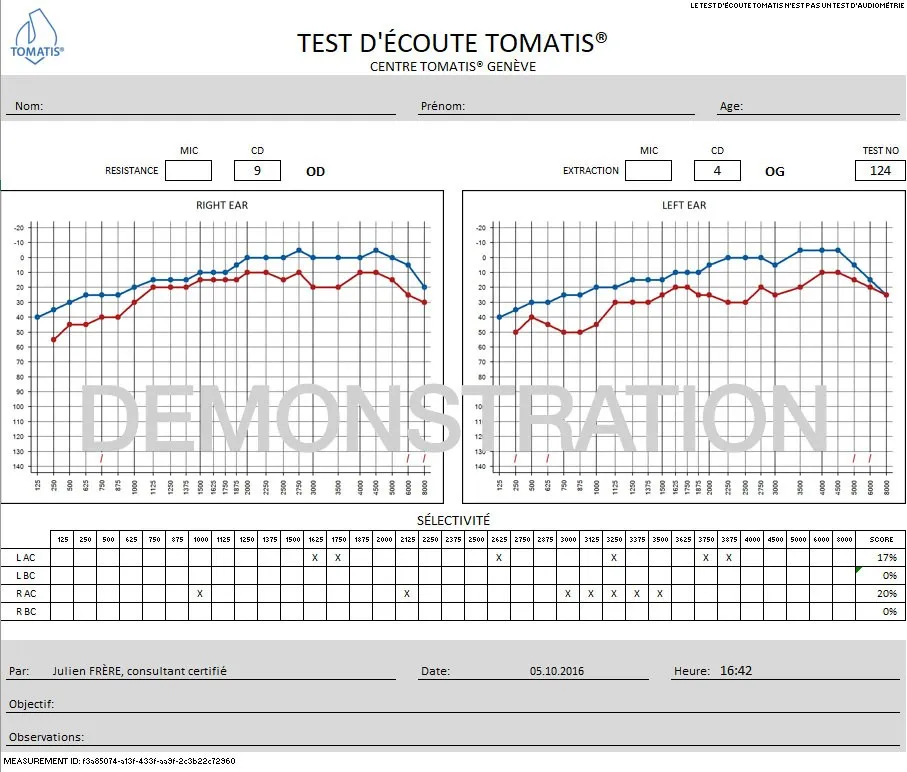
You can see two curves, one blue and one red. The blue curve shows the response of the eardrum muscle, and the red one the response of the stirrup muscle. Each has a role to play in a living ear: the eardrum passes on sounds from the outside world, while the stirrup shows how we react to those same sounds. A gap between the curves shows poor adaptation, and the source of your difficulty.
This assessment allows us to identify the areas where listening is disrupted, so that we can make targeted corrections during treatment.
In their own words
“Kevin was very receptive, even though classical music wasn't really his favourite kind of music.”
“This is the result of your support and your method, which really took a weight off my mind and helped Hakim move forward and gain confidence in himself.”
“My dad and my friends tell me I've become more mature, that I express myself much better, that my questions are more thought through.”