
Improving the singing voice
For teenagers and adults
The Tomatis method, developed by the ear, nose and throat specialist Alfred A. Tomatis, rests on the principle that any change in the way we receive and analyse a sound message affects the way we reproduce it. By using bone conduction to regulate the sound vibration we perceive, the Tomatis method improves self-listening and, as a result, the quality of the voice, whether spoken or sung.
Updated on , a 3-minute read.


Michel's testimonial
My name is Michel and I am a professional opera singer. After a professional audition in which I sang out of tune without realising it, I decided to contact the Tomatis practice in Geneva. Mr Julien Frère gave me an assessment, which turned out to be very useful because it brought to light a number of problems I had without knowing it.
So I decided to start the therapy. To be honest, I didn't believe in it at all; I had told myself that before thinking about a possible change of career I had to try everything, and I was not disappointed.
On the day of my third passive phase, sitting at home, I had a performance at the Opera that evening. Imagine my surprise when I opened my mouth on stage that night: I had never heard myself like that in my life. Everything was balanced, whereas before there had been a gap on the side of my right ear, though I hadn't known it. It was like going from mono sound to Dolby Surround 7.1, or more!
Tomatis and opera singers
Alfred A. Tomatis, an ear, nose and throat specialist, was the first to observe, around 1950, that “we sing with our ears”. He had noticed that factory workers with hearing loss often also had a distorted voice. He also noticed that opera singers with voice problems could go on to suffer hearing loss. This phenomenon was later verified scientifically and named the “Tomatis effect”.
The voice contains only what the ear hears
Alfred A. Tomatis
Improving musicality and the spoken or singing voice.
By acting directly on the brain mechanism that links perception and action, the fundamental principle of the Tomatis® method is that any change in the mechanisms for receiving and analysing a sound message will affect the way that message is reproduced, whether it is spoken, sung or played on a musical instrument.
The role of osteophony in placing the voice
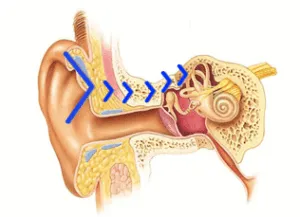
Bone conduction is why a person's voice sounds different when it is recorded and played back. Because the bones of the skull transmit low frequencies better than air does, people hear their own voice as lower and deeper than others hear it.
Mastering your voice through bone conduction
For Tomatis, good vocal work requires not only listening well to sound coming from outside, but also, and above all, good self-listening: the ability to use your own voice as a sound source to analyse and control for accuracy, intensity and quality.
This self-listening is possible provided that the sound vibration we perceive is properly regulated by bone conduction, the path by which sound travels through all the bones of the body, and in particular the skull.
This bone regulation itself depends on the smooth working of 2 muscles in the middle ear, whose role is to control and dampen all the vibrations transmitted to the inner ear.
So, depending on the voice problem, this approach can target:
- A lack or loss of the desire to sing.
- Difficulty speaking or singing easily, without feeling that you are forcing or pushing your voice.
- A lack of verbal fluency
- A lack of accuracy and precision
- A lack or imbalance of timbre, producing voices that are too dull, too high-pitched or too nasal
- A lack of expressiveness in the voice, through poor modulation or intonation
- Loss of control over intensity, too little or too much
In their own words
“It was like going from mono sound to Dolby Surround 7.1, or even more!”
“Kevin was very receptive, even though classical music wasn't really his favourite kind of music.”
“This is the result of your support and your method, which really took a weight off my mind and helped Hakim move forward and gain confidence in himself.”