Learning and language difficulties
For children, teenagers and adults
There is a group of disorders known as specific learning disorders, or “dys” disorders. A considerable number of children (4 to 6%) have them. They cannot be explained by a lack of intelligence, a disadvantaged socio-economic background or a major psycho-emotional problem.
These disorders have a neurobiological origin: certain areas of the brain did not develop properly before birth.
They include dyslexia for reading, dysorthographia for matching letters and sounds, and dyspraxia for planning and coordinating learnt movements. They also include dysphasia for spoken language and dyscalculia for maths.
Updated on , a 5-minute read.

On this page
Dyslexia
Dyslexia is one of the developmental disorders affecting language known as dysphasias, and it affects on average 5% to 10% of the population.
A person with dyslexia may speak perfectly normally, but the difficulty starts as soon as letters are involved. That is why dyslexia cannot be detected before the age of 6 or 7, when children learn to read. It is important to note that the person's other cognitive abilities are not affected, and that the degree of dyslexia varies a great deal from one person to another.
It can range from simple reading difficulties to illiteracy.
What are the most common symptoms?
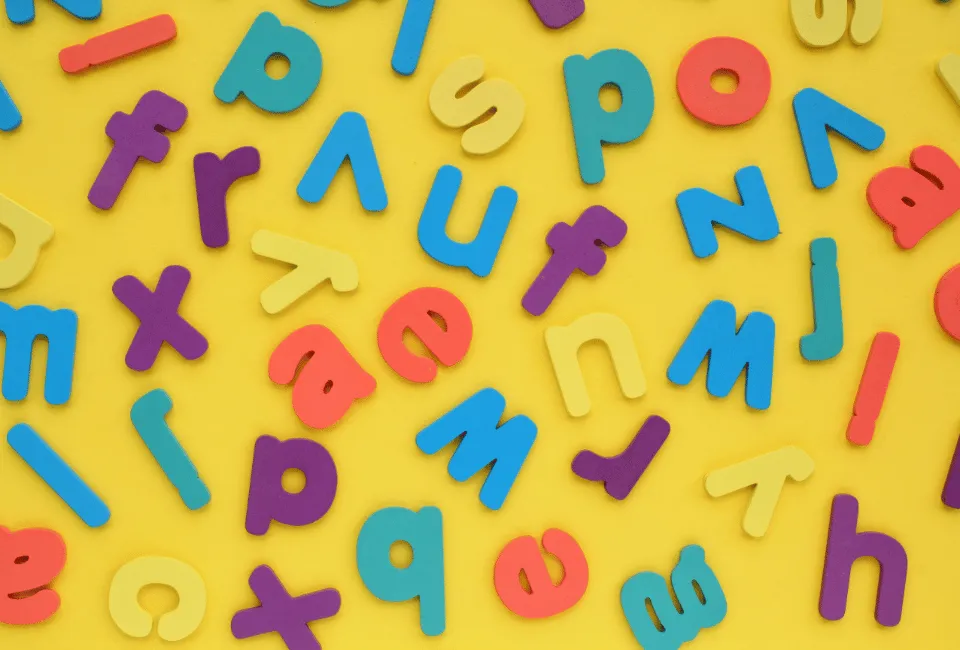
A person with dyslexia mixes up different sounds (p and b, f and v) or letters that look alike (m and n). Letters may also appear reversed to them (a d seen as a b), or even whole words (“was” seen as “saw”). In some cases where the dyslexia is severe, one word may be replaced by another that is linked by meaning or context. For example, saying cat instead of dog, both being pets.
What do we see in the brains of people with dyslexia?
Anomalies in the sensory pathways: in people with dyslexia, it has been observed that the neurons in the magnocellular layers of the lateral geniculate nucleus (a region of the thalamus involved in processing visual information) are smaller and arranged in a disorganised way. This could hinder the rapid processing of visual and linguistic information needed for reading.
Low activity in the brain areas involved: brain imaging studies have shown reduced activation of visual area V5/MT, which is involved in the dynamic processing of visual information needed to follow letters and words while reading. Reduced activation has also been found in the left temporal lobe, which is essential for processing language, especially for understanding words and sentences.
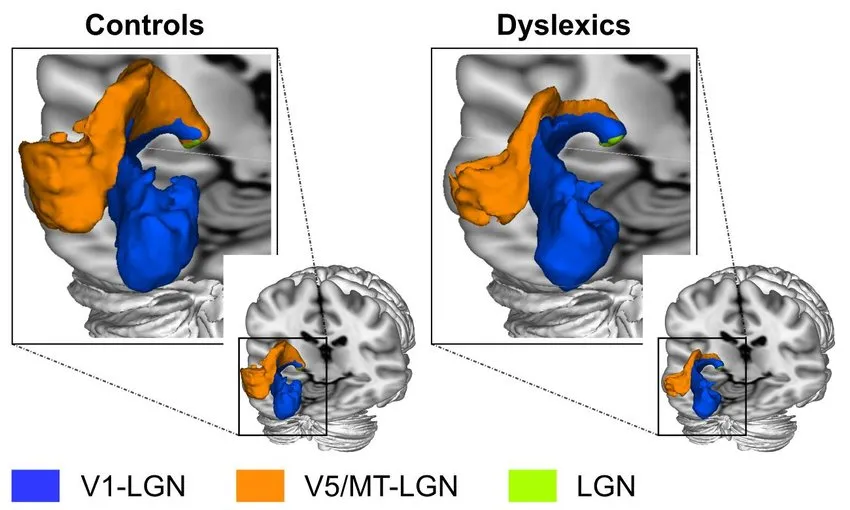
Right-hemisphere dominance: because the left hemisphere, which handles phonological, syntactic and lexical functions, is not working properly, the right hemisphere can become dominant. This means that the person with dyslexia gives more weight to context and to the emotional and tonal parts of language, and struggles when it comes to meaning, syntax or phonology.
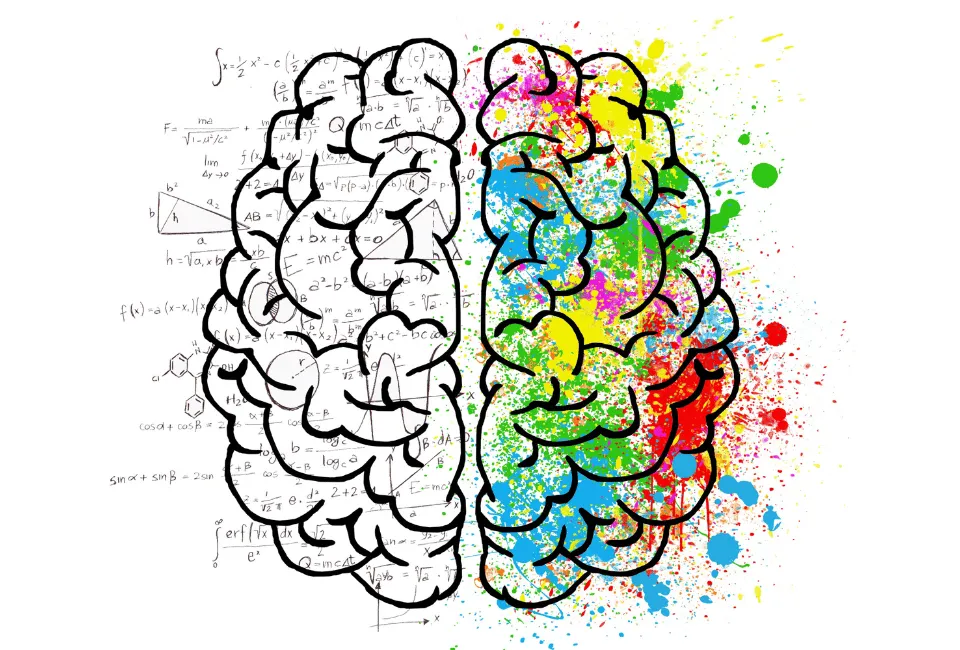
Note that this dominance of the right hemisphere, and therefore of the left ear, was brought to light by Dr A. Tomatis some fifty years ago. Years later, this discovery was confirmed by science, in particular through studies of the impact of right-hemisphere brain damage on language and on understanding context. Today there is even a branch of linguistics devoted to it: pragmatics.
How can our programme help to overcome dyslexia?
The Tomatis method combined with the Giger MD method are the two approaches we prefer for treating dyslexia, as well as the other “dys” disorders.
Better phonological processing
Listening to filtered and switched music, as we do with the Tomatis method, gradually improves the recognition and discrimination of sounds, such as being able to tell “p” from “b”. There is also a general improvement in phonological awareness: for example, being able to split words into syllables, play with them and mix them up, as in A-PRI-COT or CA-TER-PIL-LAR.
For its part, Giger MD, by making neural activation more precise, also improves the fine perception of sounds and letters, and complements the training brought by the Tomatis method.
Stronger connections between brain areas, and lateralisation
The regular training brought by Tomatis switched and filtered music stimulates brain plasticity in the regions linked to listening and language, strengthening the neural connections involved in phonological processing.
Stronger stimulation of the right ear gradually leads the person with dyslexia to connect the right hemisphere to the left, and improves overall understanding (linking context to words).
This effect is reinforced by Giger MD, which improves the precision of neural activation and the coordination between the two hemispheres.
Better sensory integration
Regular exercise on the Giger MD device improves sensory integration. Information from the auditory cortex is combined more effectively with other kinds of sensory information, especially from the vestibular system, which improves the sense of time and space, and concentration. This sensory integration is also strengthened by the exercise between the vestibule and the cochlea that takes place during Tomatis listening.
Precise, fast processing in the sensory pathways
Practised regularly, the Giger MD method improves the internal organisation of the central nervous system, which has a positive effect on the precision and transmission of information between neurons. Overall, signals are processed faster, which allows quicker recognition of letters and words, and so more fluent reading.
Activating the brain areas involved in reading
Listening, and especially listening to oneself, plays a central role in how we learn to read and recognise words. Reading exercises lateralised to the right ear stimulate the connection between the hemispheres, while music and voice processed in this way stimulate the language areas of the brain, such as the superior temporal gyrus and the auditory cortex, making it easier to understand and process texts.
Better working memory
Working memory, which holds on to information while we read, lets us grasp the overall meaning of a sentence. The Giger MD method, which improves the organisation of the central nervous system, and the Tomatis method, which brings better phonological awareness, both have a positive effect on working memory and cognitive flexibility.
Interested in our programme for “dys” disorders?
You can either book a free information session, during which you can ask your questions, or book a full listening assessment (audio-psycho-phonological assessment) at the centre, which will let us assess whether there is a listening disorder combined with a sensory integration deficit. From there, if needed, we will suggest listening training together with work to strengthen sensory integration.
In short: methods we use for learning and language difficulties and dyslexia
- Listening posture training with the Tomatis method
- Giger MD method
In their own words
“My dad and my friends tell me I've become more mature, that I express myself much better, that my questions are more thought through.”
“After just the first session, I could see that Myriam was less anxious and much more comfortable in her own skin, and she stopped her bad habit of biting her nails.”
“For the first time, he even managed a dictation with no mistakes, which had never happened before!”