Vestibular sensitivity and dizziness
For adults
The inner ear plays a crucial role in our ability to hear and to keep our balance. When the inner ear is sensitive, it can cause a range of symptoms such as tinnitus, positional vertigo and nausea. Many medicines are available to treat inner ear sensitivity, but they do not suit everyone. That is why, together with our partner ENT specialist, we looked for an innovative complementary protocol to address this problem: combining laser phototherapy with the Tomatis method.
Updated on , a 7-minute read.

On this page
Vestibular sensitivity: what are we talking about?
In a few words, it is a dysfunction of the inner ear that causes a range of symptoms, particularly in the vestibule. When these symptoms are acute, it is called Ménière's disease. Even today, there are several theories that try to explain the origin of this symptom (internal pressure that is too high, or inflammation of viral origin). On this subject, we invite you to read this very well-written article: https://www.revmed.ch/RMS/2001/RMS-2364/21671. What is certain is that it reduces the everyday quality of life of those who suffer from it, sometimes drastically in the case of Ménière's. And the treatments usually offered are far from always effective.
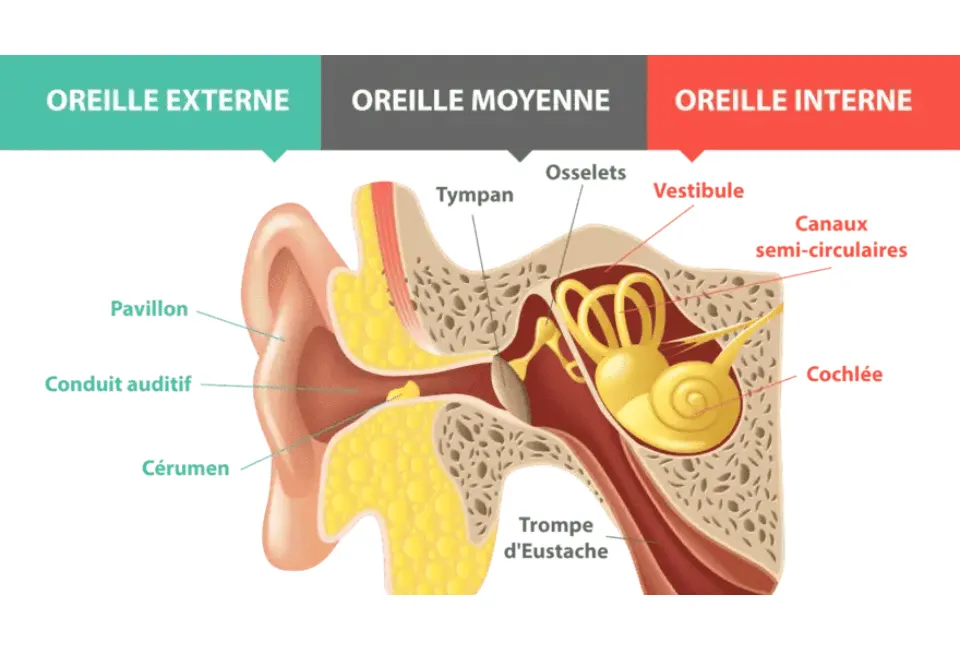
When the inner ear is sensitive, it is the vestibule and the cochlea that react. The symptoms linked to the cochlea are well known to the general public, and are usually tinnitus that comes and goes to varying degrees. The known vestibular symptoms are usually positional vertigo, such as BPPV (benign paroxysmal positional vertigo), and nausea. These symptoms are well defined when they are acute, as with Ménière's disease, but when they are milder they are often overlooked. This is because you can have vestibular sensitivity without having Ménière's disease. To help you tell whether this concerns you, here is a list of symptoms of unknown vestibular origin.
Symptoms linked to vestibular sensitivity:
- Dizziness when changing position
- Spinning vertigo (without changing position)
- Mental confusion
- Excessive fear of empty spaces and heights
- Difficulty concentrating and thinking
- Feeling drunk when you have not been drinking
- Sickness
- Difficulty with sports that need good balance (stand-up paddleboarding, skiing, climbing, etc.)
- Difficulty understanding what people say in a noisy environment
- Sensitivity to light
- Nausea, sometimes vomiting
- Marked tiredness in the middle or at the end of the day
- Needing to take regular naps
- Mild to moderate depression
- Poor sleep, sometimes in certain positions
- Intense dreams in which the physical laws of gravity do not apply (flying, floating in the air, feeling as if you are on a roller coaster; anxiety and strange sounds can also occur).
Symptoms linked to cochlear sensitivity:
- Whistling, sporadic or constant tinnitus
- Humming, sporadic or constant tinnitus
- Oversensitivity to noise (hyperacusis)
- Anxiety or even distress
- Poor sleep because of a persistent noise
These symptoms are usually chronic (with periods when they are more or less marked), and their intensity can vary. If you recognise one or more of these symptoms, we invite you to take our online test by clicking the link below: https://tomatisgeneve.typeform.com/to/YaQoL4
Our online test to find out whether you have vestibular sensitivity
How is inner ear sensitivity treated?
Many medicines exist (betahistine, diuretics, anti-emetics), but how they work is still poorly understood. The results are not satisfactory and the side effects are not negligible. That is why we have developed an innovative treatment based on focused pulsed red light: laser phototherapy of the inner ear. Combined with the Tomatis® method, it allows us to greatly improve the quality of life of the people affected.
Our solution: laser phototherapy of the inner ear and training of the stapedius muscle
Photobiomodulation in a few words
Photobiomodulation therapy is defined as the use of non-ionising electromagnetic energy to trigger photochemical changes in cell structures that are receptive to photons. Mitochondria are particularly receptive to this process. At cell level, the energy of visible red light and near-infrared (NIR) light is absorbed by the mitochondria, which are responsible for producing the cell's energy, known as “ATP”. The key to the whole process is a mitochondrial enzyme called cytochrome c oxidase, a chromophore, which accepts photon energy of specific wavelengths. The energy of visible red and near-infrared (NIR) light is absorbed by the mitochondria and converted into ATP for the cell to use, which leads to gene transcription and then to cell repair and healing.
Our process is based on a photobiomodulation effect on the cells of the inner ear. The energy of the red light, delivered locally, allows the cells to regenerate and reduces, or even completely stops, the disease processes (inflammation) that affect the vestibule and the cochlea. In doing so, we are simply stimulating and speeding up the body's natural processes. For those who want to know everything about photobiomodulation, here is a scientific article: https://www.ncbi.nlm.nih.gov/pmc/articles/PMC5436183/.
The process is completely painless, non-invasive and has no side effects at all. The treatment takes place at the centre over about ten sessions of around half an hour each, and an improvement is usually seen from the third session.
The stirrup muscle
The stirrup muscle is another name for the stapedius muscle. It is a tiny muscle in the middle ear, and the smallest skeletal muscle in the human body. The stapedius is one of the three small intrinsic muscles of the middle ear.
It is attached to the stapes (the stirrup), one of the three bones of the middle ear, and to the styloid process of the temporal bone. Its main function is to control the movement of the stapes and to protect the inner ear from loud sounds.
Training the stapedius muscle
Once the inner ear has regenerated, we begin the second part of the treatment: training the stapedius muscle with the Tomatis® method.
For Dr Tomatis, the stapes plays a very important role in damping the fluids in the inner ear. When the fluids are stirred up, they need to be regulated. That is the role of the stapes. When it does not work properly, dizziness appears. This dysfunction is often linked to stress, which is why many emotions can come up during our treatment.
What are the results, in practice?
To answer this question, we invite you to read Paula's testimonial and the testimonials below:
Testimonial received on 14 September 2019 - I had the laser phototherapy treatment at the Tomatis centre and I am fully satisfied with the results and very grateful. Thank you to the Tomatis centre for making this method known; in my case, it has given me a better quality of life. I can only recommend it. Fernanda P. - Geneva
Testimonial received on 20 April 2020 - I originally came to the Tomatis centre for hearing loss and tinnitus. However, during the listening assessment (audio-psycho-phonological assessment), Mr Frère noticed a vestibular sensitivity and explained the symptoms that go with it. Two months have passed since my 10 laser phototherapy sessions, and I have noticed a very clear improvement in my emotional state. Since my burnout at the age of 50, the months from February to April have been associated with depression. This year, despite the Covid-19 crisis and the lockdown, I am in a completely different frame of mind. It has done me a lot of good. I feel really light, well, clear-headed, sociable, and I want to say hello to everyone. On these lovely spring days, I enjoy the beauty of nature and I now feel positive about life. For all those years, I felt all that heaviness, that darkness. These sessions freed me from it. I am so positive that it affects those close to me: I cheer my partner up, I push him to get moving, whereas before I was rather aggressive with him. Now I accept him as he is; something has changed. With my ex-husband too, we have started talking again, and believe me, that was far from a given. In fact, my son said to me: “It's incredible, you've done with Dad what I've been telling you to do for years.” Lona O. - 63, Geneva.
In their own words
“Kevin was very receptive, even though classical music wasn't really his favourite kind of music.”
“This is the result of your support and your method, which really took a weight off my mind and helped Hakim move forward and gain confidence in himself.”
“My dad and my friends tell me I've become more mature, that I express myself much better, that my questions are more thought through.”